


Updated August 2026
A well-positioned luxury Cape Cod vacation rental can generate significant seasonal income, but the result depends on more than the value of the home or its peak weekly rate.
The highest-performing properties combine:
-
Premium rates during the weeks when demand is strongest
-
Strong booking conversion across the available summer calendar
-
Early exposure to guests planning high-value Cape Cod vacations
-
Active pricing adjustments as demand changes
-
Careful guest screening and property positioning
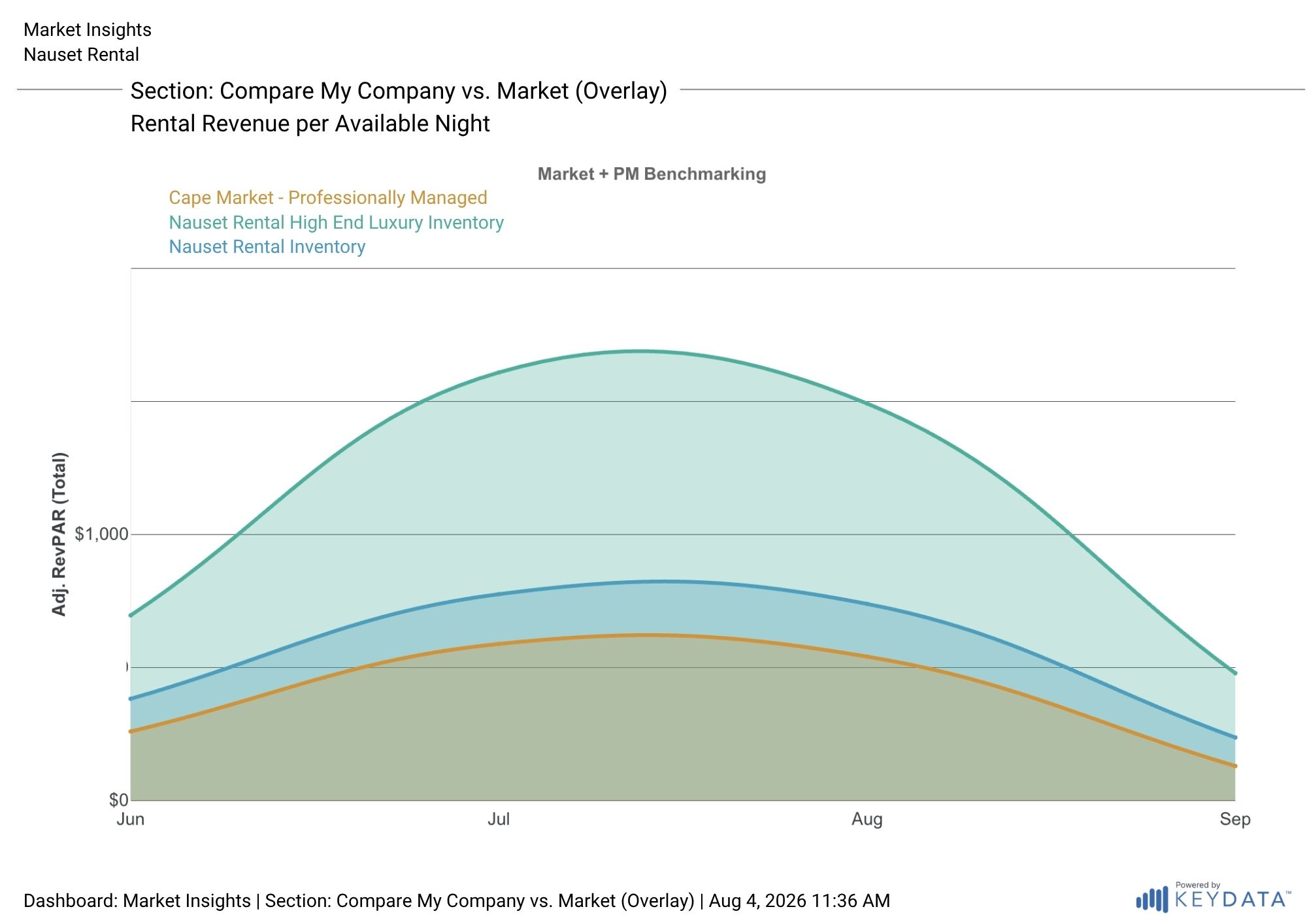
In a 2026 sample of multi-million-dollar Cape Cod homes managed by Nauset Rental, the properties produced nearly three times the revenue per available night of Cape Cod’s professionally managed vacation-rental market. They also maintained approximately 75% adjusted paid occupancy from June through September and booked an average of nearly six months before arrival.
The takeaway is not simply that luxury homes charge more. It is that a premium rate can still produce strong occupancy when the home is positioned, marketed, and priced correctly.
2026 luxury rental performance at a glance
Based on a selected Nauset Rental-managed multi-million-dollar Cape Cod homes, June through September 2026. |
|---|
The Cape Cod Rental Market Is Becoming More Competitive
The post-pandemic period of broad, automatic vacation-rental growth has given way to a more selective market. Guests have more choices and are comparing properties, rates, and destinations more carefully before they book. A high asking rate by itself is no longer a strategy: homes must be positioned correctly, opened early, and adjusted based on real booking activity.
That environment favors distinctive, well-managed luxury homes—but it also makes precision more important. The strongest properties can still command premium rates, while homes priced statically or marketed too late risk losing bookings even during otherwise strong demand periods.
Market context: Wheelhouse New England Market Data Deep Dive, July 2026; Key Data U.S. Vacation Rental Index, Q3 2026.
What Determines Luxury Cape Cod Rental Income?
There is no single income figure that applies to every luxury Cape Cod property.
Rental income varies substantially based on:
-
Town and neighborhood
-
Waterfront or beach access
-
Number of bedrooms and guests accommodated
-
Pool, central air conditioning, views, and other amenities
-
Renovation quality and interior presentation
-
Weeks made available to rent
-
Pricing and revenue-management strategy
A well-positioned luxury home generally earns the majority of its annual rental revenue during the summer season. For many homes, a limited number of high-demand weeks account for a large share of the total.
That makes peak pricing especially important. A single prime week priced materially below demand can cost an owner more than several unbooked nights during a softer period.
But peak pricing is only part of the equation.
The strongest luxury-home performance comes from securing a premium rate without allowing too much of the viable calendar to remain empty.
In Nauset Rental’s 2026 luxury inventory, the properties achieved nearly twice the revenue per available night of Nauset Rental’s broader inventory while maintaining essentially the same occupancy rates.
That means the higher revenue was not created by accepting an empty calendar in exchange for an impressive advertised rate. The homes captured a substantial luxury rate premium and still booked nearly three-quarters of their available nights.
The Most Important Metric Is Not the Highest Weekly Rate
Luxury homeowners often begin with one question:
What is the highest weekly rate my home can command?
That matters, but it is not the full calculation.
A home listed at $20,000 per week but left vacant does not outperform a comparable home that books at $17,000. Likewise, a full calendar is not necessarily a success when the property was discounted below what demand would have supported.
The more useful measure is revenue per available night, often referred to as RevPAR.
RevPAR accounts for both:
-
The rate earned when the property books
-
How much of the available calendar actually converts into revenue
ADR, or average daily rate, measures what a home earns on nights that actually book. RevPAR measures revenue across every night made available, including unbooked nights. ADR shows pricing strength; RevPAR shows how effectively the entire calendar performs.
This is why Nauset Rental optimizes for revenue rather than maximum occupancy or the highest possible asking rate in isolation.
The strongest total return from the available calendar, at an appropriate rate, with the right guests.
Why Luxury Cape Cod Rentals Need a Different Pricing Strategy
Luxury vacation rentals do not behave exactly like the broader Cape Cod market.
The pool of qualified guests is smaller, but the right guests often:
-
Plan farther in advance
-
Care more about the property itself
-
Have less flexibility around prime vacation dates
-
Place greater value on amenities, condition, design, and location
-
Are willing to pay significantly more for a property that clearly stands apart
That creates both opportunity and risk.
Price a distinctive luxury home too low, and an owner can leave significant revenue on the table during the weeks that matter most.
Price it too high without responding to booking activity, and valuable nights can remain empty even as comparable homes convert.
A successful strategy therefore begins confidently, monitors real demand, and changes by week rather than relying on one static rate card for the entire season.
Luxury Cape Cod Homes Book Earlier
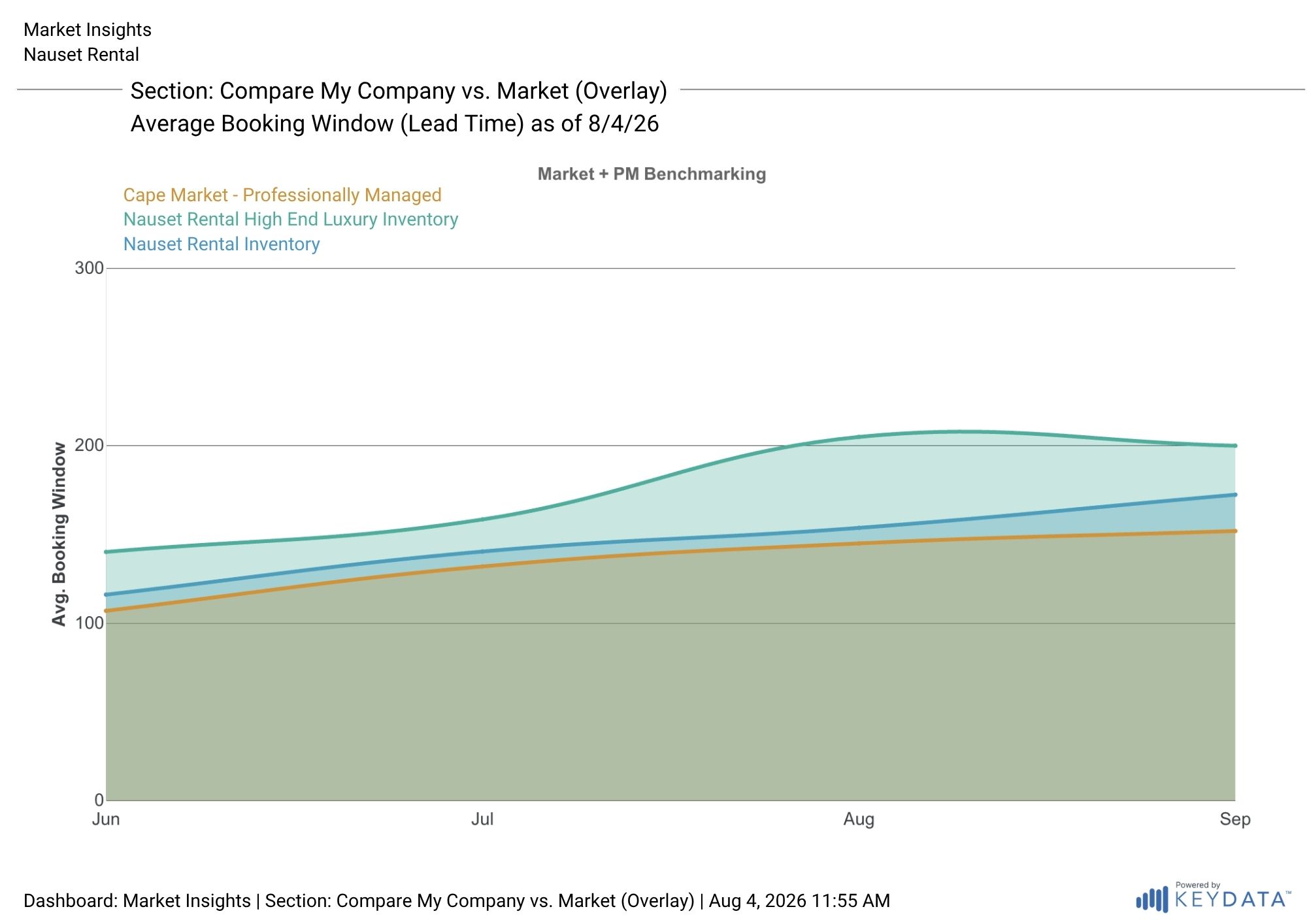
The Nauset Rental luxury homes booked an average of 177 days before arrival, compared with:
-
146 days for Nauset Rental’s broader inventory
-
131 days for the Cape Cod professional-management market
That is important because it shows that the luxury-home performance is not primarily being created through last-minute discounting.
These homes are capturing high-intent guests almost six months before arrival.
Opening the calendar early allows a manager to:
-
Reach guests while they still have the widest choice of properties
-
Establish an appropriate premium before the market becomes crowded
-
Evaluate booking pace against comparable homes
-
Protect high-demand weeks from unnecessary early discounts
-
Identify softer dates with enough time to make measured adjustments
Luxury owners who wait too long to open their calendars may miss the guests most likely to book a premium property at a premium rate.
High Rates Should Not Require Low Occupancy
A common assumption is that a premium vacation home will naturally rent less often because the qualified guest pool is smaller.
Some occupancy difference is reasonable, but a well-managed luxury home should not have to choose between a strong rate and a productive calendar.
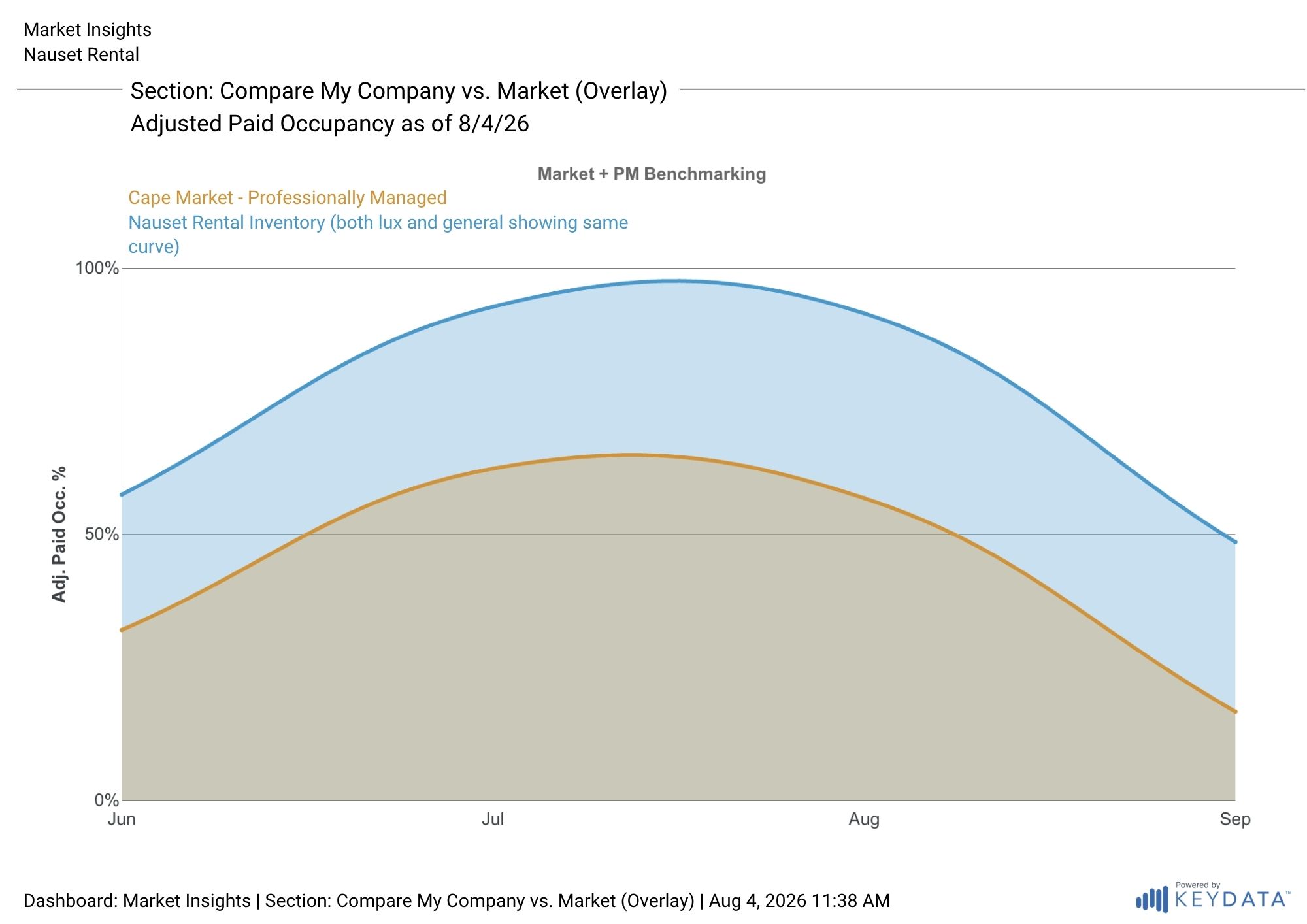
From June through September 2026, Nauset Rental’s 3+ bedroom inventory achieved approximately 78% adjusted paid occupancy, compared with approximately 43% across Cape Cod’s professionally managed market.
That means Nauset Rental converted substantially more of the available summer calendar into paid bookings, while its luxury-home inventory performed at essentially the same occupancy level as the broader Nauset Rental portfolio.
Nauset Rental’s luxury homes captured a substantial rate premium without sacrificing meaningful occupancy.
In other words, the higher revenue was not driven by a handful of expensive bookings surrounded by empty dates. The homes maintained strong booking conversion while producing significantly more revenue from each available night.
The Five Biggest Factors That Affect Cape Cod Rental Income
1. Pricing and revenue management
Pricing is the largest factor that a homeowner and manager can actively change.
An effective pricing strategy should account for:
-
Demand by specific week
-
Booking pace
-
Comparable property availability
-
Holidays and events
-
Minimum-stay requirements
-
Small gaps between reservations
-
Lead time before arrival
-
Differences between peak and shoulder season
The rate should not be changed simply to fill the calendar. It should be changed when the expected revenue from waiting becomes lower than the opportunity to secure a qualified booking.
2. Location and water access
Waterfront, water-view, and beach-close homes typically command significant premiums.
But location should be described accurately. Guests distinguish among:
-
True private waterfront
-
Walk-to-beach access
-
Water views without direct access
-
Short drives to town or beaches
-
Quiet, private settings farther from attractions
A strong marketing strategy identifies the correct audience for the home rather than treating every premium property as interchangeable.
3. Bedrooms, layout, and guest capacity
Bedroom count matters, but usable layout matters too.
A five-bedroom home that comfortably accommodates multiple families may have a larger qualified audience than a home with the same bedroom count but a less flexible layout.
Guests also consider:
-
Number and placement of bathrooms
-
Primary suites
-
Bunk rooms
-
Separate living spaces
-
Indoor and outdoor gathering areas
-
Privacy between sleeping areas
Local regulations also matter. Town occupancy limits, registration requirements, rental taxes, septic capacity, parking rules, and other local restrictions may affect how many guests a home can legally accommodate and how it may be rented.
4. Amenities and condition
For luxury renters, amenities influence both rate and booking conversion.
High-impact features often include:
-
Pool or hot tub
-
Central air conditioning
-
Updated kitchen
-
Water views
-
Outdoor shower
-
High-quality outdoor living space
-
Game room or secondary family room
-
Professional interior presentation
-
Reliable internet and work space
At the top end of the market, condition and photography are not secondary. They are part of the product.
5. Calendar availability
Owners retain control over when their home is available.
Peak weeks generally produce the greatest income, so blocking multiple high-demand weeks will materially change the seasonal total.
Shoulder-season availability can provide additional revenue, but the approach should be different from peak summer. The target guest, minimum stay, pricing, and screening standards may all need to change.
Peak Season Sets the Number—But the Full Calendar Still Matters
The highest-demand summer weeks usually establish the foundation of a Cape Cod rental season.
Those weeks should be priced according to actual demand, not according to:
-
Last year’s static rate
-
A nearby home that is not truly comparable
-
An owner’s preferred number
-
A blanket percentage increase
-
The highest-priced listing visible online
At the same time, a few premium weeks do not excuse weak performance across the rest of the viable season.
Nauset Rental’s broader portfolio results show that the company’s advantage does not come exclusively from charging higher rates. Across the relevant market data, Nauset Rental converts substantially more of the available calendar while maintaining healthy rates.
The luxury-home results add another layer: high-end homes can capture a much larger rate premium while retaining strong occupancy.
That is why luxury revenue management requires both:
-
Rate discipline during high-demand weeks
-
Active calendar management before and after peak
Why Maximum Occupancy Is Not the Goal
A completely full calendar may look impressive, but it can also indicate that a home was priced too low.
Nauset Rental does not optimize for occupancy at any cost.
During peak demand, the strategy is to capture the rate the market will support. During softer periods, rates may be adjusted, but not simply to make an occupancy percentage look better.
There are also bookings that should not be accepted.
For a high-value home, guest quality, group composition, intended use, and risk to the property remain part of the revenue decision.
One additional booking is not worthwhile when:
-
The rate does not cover the operational burden
-
The guest is a poor fit for the property
-
The stay creates excessive turnover or damage risk
-
The booking weakens the home’s positioning
-
The net return is too low after expenses
The goal is not the most guests. It is the strongest owner return from appropriate guests while protecting the property.
Do Luxury Cape Cod Homes Rent in Spring and Fall?
Yes, but spring and fall should generally be treated as upside rather than as the foundation of the season.
Shoulder-season demand is smaller and often more price-sensitive. Guests may also be looking for:
-
Weekend stays
-
Weddings and events nearby
-
Adult group trips
-
Remote-work stays
-
Holiday weekends
-
Quieter Cape experiences
-
Smaller groups attracted to a premium home at a lower seasonal rate
The answer is not necessarily to apply a large blanket discount.
A better strategy may include:
-
Shorter minimum stays
-
Different weekday and weekend pricing
-
Earlier calendar exposure
-
Targeted marketing
-
Gap-night adjustments
-
Careful screening of shorter-stay groups
For luxury homes, the objective is to create incremental revenue without undermining the home’s position or accepting avoidable risk.
Is Winter Rental Income Worth Pursuing?
For most high-end Cape Cod vacation homes, winter demand is limited.
Owners should consider the full cost of operating during the winter, including:
-
Heating
-
Storm exposure
-
Snow and ice management
-
Cleaning and turnover
-
Property checks
-
Maintenance risk
-
Lower achievable rates
-
Greater dependence on short stays
A small amount of gross winter revenue may not create meaningful net income after those costs and risks are considered.
For many luxury properties, the stronger strategy is to focus on the viable spring-through-fall rental window rather than pursuing occupancy year-round.
What Does the 2026 Market Mean for Cape Cod Rental Owners in 2027?
The clearest lesson from 2026 is that luxury demand remains available, but it cannot be treated as automatic. For 2027, high-end Cape Cod homeowners should plan for a market in which the best properties continue to perform well while differences in pricing, presentation, booking timing, and management become more visible.
Based on Nauset Rental’s 2026 performance and current market conditions, luxury homeowners should:
-
Open their 2027 calendars early enough to reach guests planning six months or more in advance
-
Begin peak weeks at a confident, data-supported rate rather than discounting early
-
Monitor booking pace by individual week instead of waiting until the entire season appears soft
-
Make measured adjustments to weaker weeks before demand becomes dominated by last-minute, price-sensitive guests
-
Continue investing in the amenities, presentation, and property condition that distinguish a luxury home from the broader rental market
Nauset Rental expects 2027 to reward well-positioned luxury homes, but performance is likely to become increasingly uneven. A premium property with active revenue management may continue to outperform, while simply listing an expensive home at an expensive rate will not be enough.
Is a Professional Rental Manager Worth It for a Luxury Cape Cod Home?
For many owners of high-end Cape Cod homes, the question is not simply whether to hire a manager—it is whether that manager can produce enough additional revenue, protect the property, and reduce the owner’s workload to justify the fee.
The management percentage alone does not answer that question. Owners should compare the manager’s performance across the full available calendar, including:
-
Revenue per available night
-
Peak-week pricing
-
Occupancy and gap-night performance
-
Booking lead time
-
Direct and repeat demand
-
Guest screening and property protection
-
Local operational support
-
Total owner net income after all fees
A manager charging less can still leave the owner with less if rates are static, key weeks are underpriced, or too much of the viable calendar remains empty.
Why Nauset Rental’s Model Is Different
Nauset Rental is a local, family-owned Cape Cod vacation-rental company founded in 2014 through roots at MIT and on the Outer Cape. Vacation-rental performance is Nauset Rental’s core business—not an add-on to real estate sales or a portfolio managed remotely from another market.
Nauset Rental takes on a select number of homes so that each property receives active attention. The approach combines localized revenue-management technology, week-by-week pricing oversight, professional marketing, direct guest demand, careful guest screening, and local operations.
More than 70% of Nauset Rental bookings are made directly rather than through major listing platforms. That reduces dependence on third-party channels and helps Nauset Rental build repeat guest relationships over time.
In one recent example, an owner moved to Nauset Rental after a local company had rented only part of the available season. During the home’s first year with Nauset Rental, rental income increased by approximately 90% through a combination of broader calendar availability, stronger positioning, and active pricing. Individual results vary, but the example illustrates why management performance should be evaluated by total owner return—not commission rate alone.
Get a Personalized Cape Cod Rental-Income Estimate
Generic market averages cannot account for your home’s exact location, water access, amenities, condition, guest capacity, and owner-use schedule.
Nauset Rental’s complimentary rental-performance estimate considers:
-
Town and neighborhood
-
Water access
-
Bedrooms and guest capacity
-
Amenities
-
Property condition
-
Comparable rental performance
-
Owner availability
-
Likely seasonal pricing
-
Expected booking patterns
You will receive a realistic range and an explanation of the assumptions behind it.
Frequently Asked Questions
How much can a luxury Cape Cod vacation rental earn?
Luxury Cape Cod rental income varies based on location, water access, size, amenities, condition, calendar availability, and pricing. Most seasonal income is earned during the spring-through-fall rental window, with peak summer weeks contributing the largest share. A home-specific rental estimate is more reliable than a broad Cape Cod average.
What is RevPAR for a vacation rental?
RevPAR means revenue per available rental night. It accounts for both the rate a home earns when booked and the percentage of its available calendar that books. It is often more useful than looking at either nightly rate or occupancy alone.
How far in advance do luxury Cape Cod rentals book?
In Nauset Rental’s 2026 luxury-home inventory, reservations booked an average of 177 days before arrival. That was 46 days earlier than the Cape Cod professional-management benchmark. The luxury inventory also recorded substantially higher revenue per available night.
Do luxury Cape Cod homes have lower occupancy?
Not necessarily. Nauset Rental’s luxury-home inventory achieved approximately 74.9% adjusted paid occupancy from June through September 2026, compared with 42.5% for the Cape Cod professional-management benchmark. Results depend on pricing, timing, marketing, property quality, and calendar availability.
Should I try to achieve 100% occupancy?
No—not necessarily. A full calendar can indicate that a property was priced below demand. A successful strategy maximizes revenue while managing guest and property risk across the dates the owner chooses to make available.
When should I open my Cape Cod rental calendar?
Luxury homes should generally open well in advance of the season because premium guests often plan earlier. Opening early provides more opportunity to capture high-intent demand, evaluate booking pace, and make measured pricing decisions. In Nauset Rental’s 2026 luxury-home inventory, reservations booked an average of 177 days before arrival.
Do luxury Cape Cod homes rent during the shoulder season?
Yes, although demand is lower than during peak summer. Spring and fall performance often requires different minimum stays, more flexible pricing, targeted marketing, and careful guest screening.
What percentage do Cape Cod vacation-rental managers charge?
Management fees vary by company and service level. Owners should compare total fees and expected net income rather than the commission percentage alone. Pricing performance, occupancy, guest screening, distribution costs, and property care can all materially affect the owner’s final return.
Can I use my home and still rent it?
Yes. Nauset Rental owners can reserve dates for personal use and make the remaining calendar available for guests. Blocking prime summer weeks will reduce the property’s potential seasonal income.
How is Nauset Rental different?
Nauset Rental combines local Cape Cod expertise, dynamic pricing, market data, direct booking demand, active calendar management, guest screening, and local operations. Nauset Rental takes on a select number of properties and focuses on total owner return rather than one isolated metric.
Data Methodology
Nauset Rental luxury-home figures reflect a selected inventory of multi-million-dollar homes managed by Nauset Rental. Cape Cod comparison figures reflect professionally managed houses with 3–6 bedrooms. Results cover June 1 through September 30, 2026, using Key Data market benchmarking viewed August 4, 2026. Individual results vary based on location, amenities, condition, pricing, owner availability, and other property-specific factors.